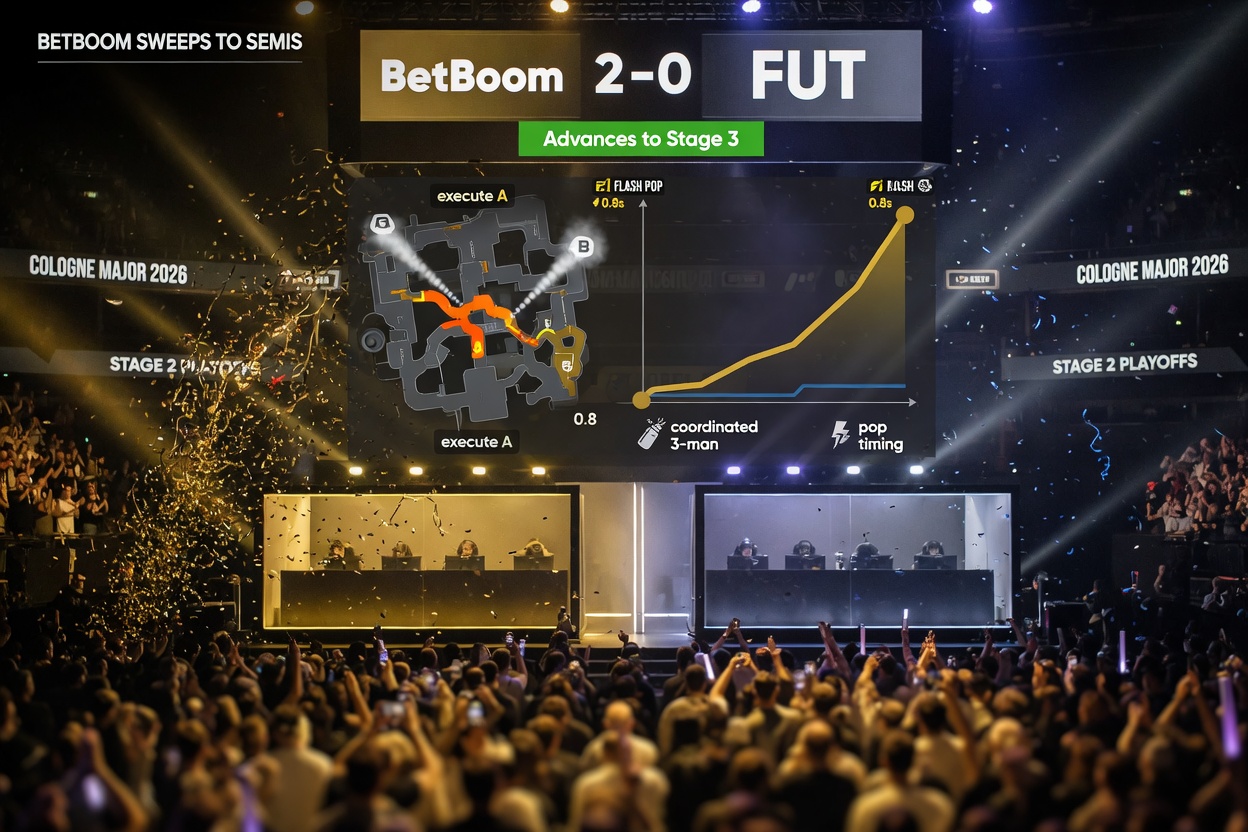
BetBoom Team crushes FUT Esports 2-0 to advance in IEM Cologne Major 2026 Stage 3
The 2-0 result in favor of BetBoom Team over FUT Esports at the IEM Cologne Major 2026 represents a clear progression to Stage 3 within the tournament framework. Such a scoreline, while concise, often masks the layers of strategy, adaptation, and mental resilience that determine success on a big stage. This article examines the match in evergreen terms, exploring the tactical themes, match management, and broader implications for teams moving deeper into a major.
Strategic themes and map control
Victories at the top level usually reflect coherent strategic planning rather than isolated plays. A 2-0 outcome suggests that BetBoom Team executed their game plan across multiple maps in a way that limited FUT Esports’s options. Typical elements include consistent mid-round decision making, efficient utility usage, and a clear division of roles among players.
Map control is a recurring theme in successful outings. Teams that secure key areas methodically and convert map control into round wins tend to stay ahead on the scoreboard. Clean rotations, timely trades, and predictable post-plant setups are practical building blocks that support map dominance without relying on individual heroics.
Adaptation and momentum
Advancement in a major often depends on a team’s ability to adapt between rounds and maps. When a squad wins in straight maps, it can indicate effective halftime adjustments and improved reads on the opponent’s tendencies. Such adaptability may come from coaching input, in-game leadership, or pre-game preparation that anticipates likely enemy strategies.
Momentum management is equally important. Winning successive rounds can create pressure that forces opponents into riskier decisions. Teams that convert momentum into disciplined play — avoiding unnecessary aggression while maximizing high-value rounds — typically preserve their lead and close out maps more cleanly. Conversely, teams that fail to respond constructively to losing streaks may suffer lapses in coordination.
Mental game and tournament progression
Reaching Stage 3 of a major elevates the stakes, and psychological factors become more pronounced. Confidence gained from advancing can sharpen focus, but it can also bring additional scrutiny and expectations. Players and staff who maintain routine, manage stress, and communicate clearly tend to navigate the increased pressure better than those who do not.
For teams that fall short, evaluation tends to center on resilience and learning. A single match score does not define long-term potential; rather, how a team analyzes its performance and integrates lessons into practice determines future growth. Advancing teams often use such moments to refine their preparation for opponents at even higher competitive tiers.
Practical takeaways for teams and analysts
There are several practical lessons from a straight-sets victory at a major. First, clarity of roles and reliable execution under pressure are essential. Teams should emphasize role stability in practice and simulate high-pressure situations to build automatic responses.
Second, preparation for map pools and opponent tendencies should be iterative. Thorough demos review, scenario planning, and flexible utility setups allow teams to pivot quickly during matches. Finally, communication protocols that minimize noise and maintain decisiveness contribute directly to consistent outcomes on stage.
What advancement typically signals
Progressing to Stage 3 in a major usually indicates a blend of technical skill, strategic depth, and organizational stability. It can signal readiness to face the tournament’s elite, where margins are slimmer and adaptations must be faster. For observers and analysts, such advancement provides a clearer sample of a team’s strengths and areas requiring improvement.
However, the long-term significance of any single match should be assessed within a broader context of performance trends and competitive history. Teams that sustain high-level results do so by continuously evolving, while single victories are best treated as informative pieces of a larger competitive puzzle.
Conclusion
The 2-0 result in favor of BetBoom Team over FUT Esports at the IEM Cologne Major 2026, culminating in Stage 3 advancement, highlights recurring themes of map control, adaptation, and mental discipline. Straight-set victories often reflect strong preparation and execution across multiple dimensions of play rather than isolated moments of brilliance. Moving into deeper stages of a major brings new challenges, and both advancing and eliminated teams can draw practical lessons from the match to inform future strategy and development.
